 Wallet
Sample reports
Samples based on a public rug-pull case ($LIBRA, Feb 2025), with the example buyer's wallet redacted.
SAMPLE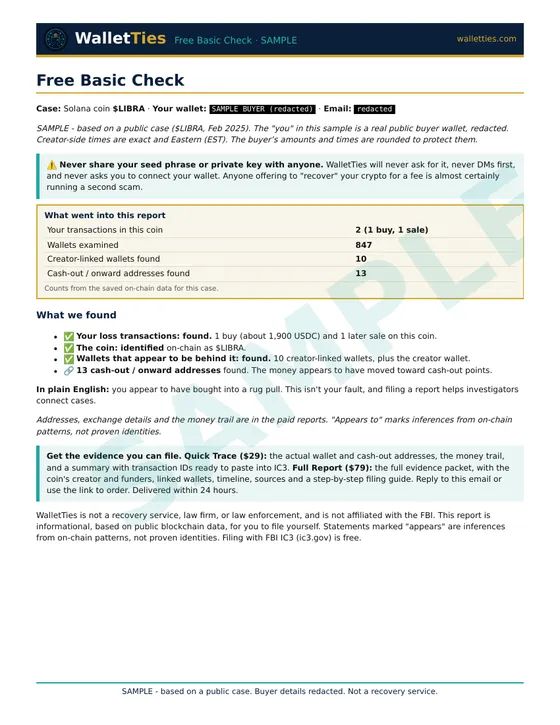 Free Check sample (PDF)
SAMPLE
Free Check sample (PDF)
SAMPLE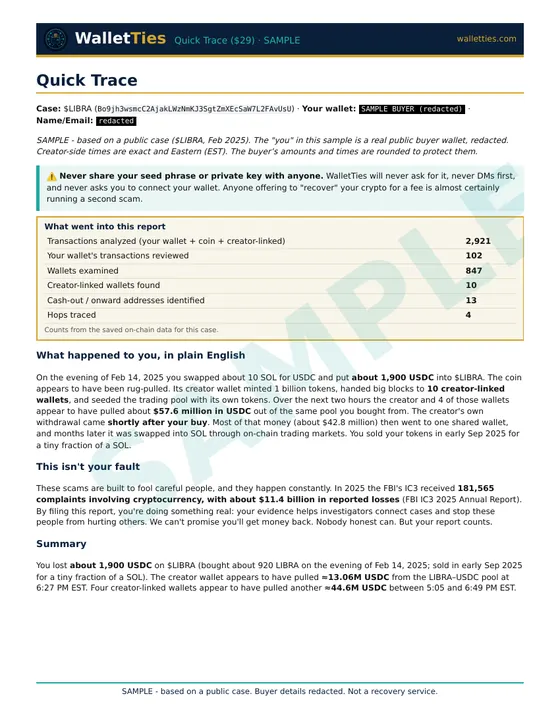 Evidence Report sample (PDF)
SAMPLE
Evidence Report sample (PDF)
SAMPLE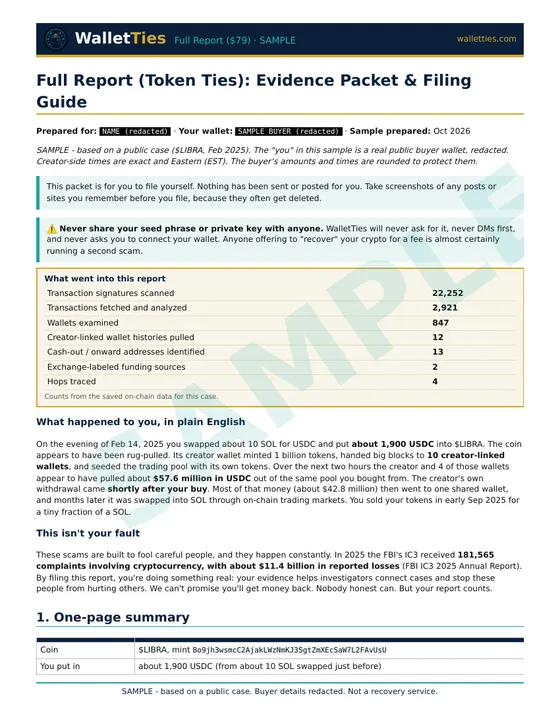 Full Investigation sample (PDF)
Free Check sample (PDF)
SAMPLEEvidence Report sample (PDF)
SAMPLEFull Investigation sample (PDF)
What went into the sample Full Investigation
| Transaction signatures scanned | 22,252 |
| Transactions fetched and analyzed | 2,921 |
| Wallets examined | 847 |
| Creator-linked wallet histories pulled | 12 |
| Onward and likely exchange deposit addresses identified | 13 |
| Hops traced | 4 |
Counts from the saved on-chain data for this sample case. Every report shows its own real counts.
What you get (Full Investigation)
- A one-page summary in plain English
- A timeline of the relevant transactions we found, with links you can check on public explorers
- A map of the wallets your money (or the coin's money) is tied to
- Exchange deposit addresses where possible (exchanges can respond to law-enforcement requests)
- A ready-to-paste IC3 complaint section, plus a checklist for screenshots and other evidence
- Each report is reviewed by a person before it's sent
- Delivered by email within 24 hours
What happens next
- Get your report. Delivered by email within 24 hours, reviewed by a person before it's sent.
- File it at ic3.gov yourself. Your report includes a ready-to-paste IC3 complaint section.
- Send the report to the exchange the money went to. Exchanges can respond to law-enforcement requests.
Every transaction leaves DNA
Years ago, criminals didn't think about DNA because it wasn't a thing yet. Then the science caught up, and cold cases started getting solved decades later. Crypto works the same way. Every transaction is recorded on the blockchain forever, and AI can now follow and link those trails at a scale no one could before. Scammers think there are no consequences. The evidence is already there, and it's only a matter of time before it catches up with them.